


2026/08
2026/10
Text by BCD

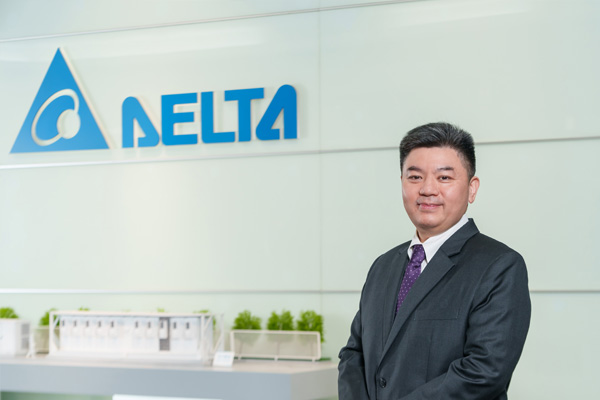
Amid global supply chain shifts and the AI surge, Southeast Asia is emerging as a critical global hub. Yet navigating this fragmented region, with its vast cultural and regulatory divides, requires more than technological strength; it demands operational resilience. In this feature, Jason Yuan, President of Southeast Asia & ANZ at Delta, draws on nearly 30 years of global tech leadership to unpack how Delta leverages engineering excellence to power AI infrastructure and clean energy microgrids, turning global strategy into local impact.
"Southeast Asia is never a single monolithic market; it is a diverse, vibrant ecosystem," says Jason. Reflecting on his first year at the helm of Delta's regional operations, this insight stands as his most fundamental takeaway.
While the region was historically viewed as a low-cost manufacturing substitute, geopolitical shifts have propelled it into a cornerstone of the global supply chain. Today, Southeast Asia hosts a dynamic convergence of multinational enterprises from mainland China, the US, Japan, South Korea, and Taiwan. Crucially, this footprint now spans the entire value chain, covering frontline consumer markets, advanced R&D centers, and upstream and downstream manufacturing clusters.
Such diversity demands that companies navigate disparate regulatory frameworks and local business practices. At the same time, it sparks immense innovation and cross-border collaboration. For Jason, there are no one-size-fits-all shortcuts: long-term success hinges on understanding each country's unique nuances within an evolving competitive landscape.

Celebrating a significant milestone at the Johor Bahru Office Opening Ceremony, joined by Jason (second from right), Delta leadership, and distinguished guests from Malaysian Investment Development Authority.
To capture this momentum, Jason has translated the region’s opportunities into four interconnected growth pathways across Southeast Asia and Oceania.
At the foundation, Delta is actively powering AI and telecommunications infrastructure by providing mission-critical power, energy management, and advanced liquid cooling architectures to support next-generation data centers, 6G deployment, and edge computing. In tandem, the company is advancing AI hardware smart manufacturing across the regional supply chain, delivering tailored industrial power and microgrid solutions specifically for server assembly and burn-in testing, where full-load test facilities consume power on par with mid-sized data centers.
Extending these capabilities into specialized vertical applications, Delta also targets heavy-industry decarbonization in markets like Australia by deploying high-reliability extreme-environment microgrids, battery energy storage systems, and megawatt-class charging infrastructure. Finally, to address distributed demand across broader commercial sectors, Delta is cultivating an expansive local partner network, ensuring its sustainable technologies and core expertise take root in every tier of the regional market.

Jason sharing his vision for sustained regional growth and cross-border collaboration.
As generative AI transitions from foundational model training to widespread enterprise inference, computing capacity must move closer to end users to reduce latency.
"Southeast Asia is exceptionally dense in population. While it will account for around 5% of global GDP growth over the next five years, it represents nearly 8% of the world's population," Jason explains. "That represents an extraordinary market opportunity." This demographic dividend and accelerated digital adoption are pulling hyperscale and colocation data centers toward consumer-adjacent hubs across Southeast Asia.
Crucially, this downstream data center migration has triggered an upstream hardware clustering effect. Driven by supply chain resilience and geopolitical diversification, the entire AI server ecosystem, spanning discrete component sourcing, final assembly, and validation, is consolidating across the region. This dual wave presents an ideal entry point for Delta.
"The explosion of data centers, the clustering of the AI server supply chain, and national net-zero commitments across Southeast Asian governments—these three powerful tailwinds converge directly in Delta’s sweet spot," Jason notes with conviction.
With decades of domain expertise in high-efficiency power electronics, thermal management, and comprehensive energy infrastructure, Delta addresses pressing grid-modernization and decarbonization demands. By delivering energy-efficient solutions for governments, industries, and local enterprises, the company firmly embeds its sustainability ethos into the regional fabric.

Jimmy Yiin, Executive VP of Global Business Operations and Jason (right) visiting the Fortescue mine in Australia, engaging with key partners to explore future collaboration and growth opportunities.
Jason's remit also covers Oceania. A recent visit to Perth highlighted Delta’s potential in mission-critical applications, where mining giants are aggressively pursuing electrification and autonomy.
"Seeing three-story-tall haul trucks transition from diesel engines to pure electric power was incredible," Jason recalls. Supporting these giants requires massive battery capacity, high-power drivetrains, and ultra-fast charging backed by robust power architecture. Furthermore, remote mine sites that battle temperatures from below freezing to over 50°C function as natural, self-sustaining microgrids powered by local solar and wind.
"If Delta’s energy solutions can reliably power the heaviest industrial equipment under the harshest physical operating conditions on Earth, that is the ultimate proof of engineering excellence," Jason affirms. Proving these capabilities in the mining sector unlocks significant opportunities across other mission-critical industrial sectors.

Connecting with the Philippines team in an open roundtable discussion to address inquiries and share insights.
To execute this vision across a fragmented geography, Jason established a flexible matrix management model, "Centralize what must be centralized, and decentralize what must be localized."
Today's cross-border business landscape is defined by multinational orchestrators. A data center operator or tech giant may base its regional leadership in Singapore while simultaneously constructing multi-gigawatt facilities across Malaysia, Indonesia, and Thailand. A conventional country-by-country sales approach cannot serve these complex accounts.
To bridge this gap, Delta deployed a centralized Regional Account Team operating out of regional headquarters. This team engages directly with key customers' Asia-Pacific leadership on top-level strategy, capacity planning, and resource allocation.
In parallel, Local In-Country Teams across seven nations, including Southeast Asian markets and Australia, drive frontline execution. Once strategic terms are aligned in Singapore, local engineering, sales, and field-service teams take over in-country: managing site construction in Malaysia, navigating local regulatory requirements, and providing ongoing operational support. This model balances high-level strategic alignment with agile, on-the-ground customer intimacy.

Jason (in the foreground) sharing a lighthearted moment with the Singapore team.
Unifying regional operations under the "One Delta" umbrella inevitably surfaces organizational complexity.
"Wherever you have people, even within a single country, you encounter different perspectives. In a multinational team, those differences multiply," Jason reflects. However, he views cultural divergence as a catalyst rather than an obstacle. "Diverse perspectives unlock breakthrough creativity. When making pivotal decisions, actively embracing varied viewpoints gives our strategic steps far greater conviction and stability."
Guiding this transformation, Jason integrates structured change management into daily operations by building awareness of the vision, igniting intrinsic desire to achieve it, providing training alongside psychological safety, and reinforcing success through tangible recognition.

Jason (third from left) capturing memories with teams from Southeast Asia at the Delta Singapore Dinner & Dance 2025.
Bringing decades of executive experience from IBM and Microsoft, Jason marks his first year at Delta with an open and humble beginner's mindset, anchored by three defining cultural pillars.
Central to this philosophy is a genuine respect for people, reflected in an authentic care for employees from executive leadership downward that remains rare in a hyper-competitive tech landscape. Equal in weight is a dedication to long-term conviction, prioritizing sustainable societal and environmental value over short-term quarterly pressures. Underpinning it all is Delta’s engineering excellence, where a deep-tech research and development heritage earns lasting credibility on the global stage.
By bridging cultures, empowering cross-border teams, and staying firmly grounded in local needs, Jason continues to steer Delta’s pragmatic culture toward a resilient and sustainable future a
2026/08

2026/06
2026/04
2026/02