


2026/10
2026/08
Text by Brand and Communications Division

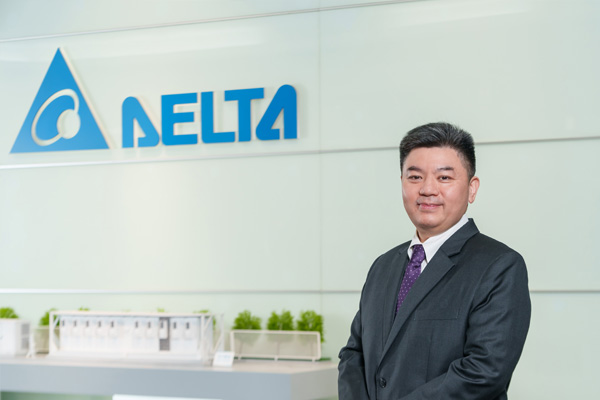
Driven by sustainability goals, AI, and edge computing, autonomous buildings are emerging as a defining trend in the industry. Amidst fierce competition, Delta’s ability to leverage global brand synergies is key to its continued growth. In this interview, Hong Wu, GM of the Building Automation Business Group (BABG), shares his journey one year after taking the helm. Combining his 16 years of top-tier global management experience with AI and building automation, he is integrating global resources to build a "One Team" culture and shape the future of innovative buildings.
"Imagine buildings in ten years as self-driving cars—they will perceive, decide, and act autonomously. Through continuous learning, they will create smarter and more livable spaces!" Hong vividly described.
Moving from passive monitoring to active decision-making, this evolution toward "Autonomous Buildings" deeply impacts global carbon reduction and energy management. At the core of this transformation, BABG is strengthening its competitive position through the deep integration of its global brands and technologies.
Reflecting on his first year leading the group, Hong smiled. "It's hard to believe a full year has already passed! I remember telling the interview team in 2025: 'Give us a year to deliver real results before we talk.' I didn't expect this day to come so fast!"
As the conversation shifted to BABG's core business, Hong's expression turned more focused. Since its founding in 2016, the group has built a portfolio spanning six brands. Beyond its proprietary Delta brand, the group has successfully acquired Delta Controls, LOYTEC, VIVOTEK, March Networks, and Amerlux. Relying heavily on "brands" and "solutions" rather than single hardware sales, they work with nearly 2,000 global partners.
"However, for the past decade, these five subsidiaries operated independently as separate profit centers," Hong noted, pointing out past pain points. "This resulted in organizational silos. We had great potential for synergy, but it wasn't being fully utilized."
To unlock this potential, he drove a massive organizational shift. "Over the past year, we made a critical change: fusing these companies into one powerful business group. We now align revenue opportunities instead of focusing solely on single-brand performance," Hong stated firmly. "We are integrating overlapping capabilities at the foundational level so the team can truly fight together and offer complete solutions to global clients."
A major milestone was VIVOTEK becoming a 100% Delta-owned subsidiary in 2026, removing previous "related-party transaction" limits. "Now, Delta's massive manufacturing and supply chain resources can be fully utilized. This has vastly improved VIVOTEK's material management and factory automation."
Addressing employee concerns during the transition, Hong shared, "Our biggest worry was that people would leave due to uncertainty. So, we send out a monthly 'Fireside Chat' newsletter to transparently communicate our actions and future plans. To my surprise, overseas colleagues even asked, 'Why did it take ten years to do this?' This shows everyone eagerly wanted the 'One Team' strategy to become a reality."

Hong connected with teams at Townhall meetings in Ottawa (top) and Vancouver (bottom) to foster a transparent, open, and trusted communication culture.
Organizational changes are just the start. Hong has outlined clear short- to long-term goals.
"In the solutions business, operational integration is as critical as front-end sales," Hong said, comparing short-term goals to "laying the groundwork." "These five companies had entirely different ERP and CRM systems, and even their bill-of-materials (BOM) structures were not aligned. Without integrating these systems, data cannot be shared effectively, nor can we fully leverage Delta's global supply chain." Initially, the team launched cross-selling across global channels to create immediate growth momentum.
The mid-term goal focuses on aligning product roadmaps and rebranding. "Subtracting is often harder than adding. We must decisively choose which products to keep and which to retire to avoid resource overlap," Hong admitted, expecting to clarify each brand's positioning from the bottom up.
"Our goal is true 'One Operation.' By integrating global production and R&D centers, we aim to create a borderless 'Big Data Family' culture. This ensures consistent workflows and values while preserving local diversity."

Security and Buildings teams aligned at Global Sales Kickoffs in London (top) and Fremont (bottom) to accelerate cross-channel and cross-brand sales.
In the booming smart building and energy-saving market, competition is fierce. Hong remains highly confident. "Compared to century-old competitors, we are currently smaller, which means we have huge room to grow and capture market share!"
He highlighted three core advantages: a collaborative global R&D network, nearly 2,000 channel partners, and Delta's massive corporate resources. "With Delta's smart manufacturing, new production line efficiency increased by 50% in just two months! This directly translates into a meaningful competitive advantage."
This synergy is already yielding global results. Hong shared a recent win, saying, "A North American teen apparel client with over 500 stores was considering a competitor's cloud BI solution. In just a month, we combined VIVOTEK's edge computing cameras, VORTEX cloud service platform, and March Networks' video analytics. This system not only ensures security but uses AI to accurately analyze foot traffic and checkout efficiency. The customer decided to move forward with the solution!"

Hong (center) welcomed Vice President Hsiao Bi-khim at Secutech Taiwan to showcase leading security solutions and industry impact.
Another success involved a major North American sporting goods retailer. "We previously lacked high-bay lighting there. After integrating our brands, we introduced Taiwan's superior high-bay lights to North America," Hong said proudly. "The client was amazed by the energy efficiency and is adopting them in all new and existing stores. It demonstrated the value of cross-brand collaboration!"
The industry is buzzing about "Autonomous Buildings." "They are like self-driving cars, evolving from traditional to autonomous operation," Hong compared. Unlike current "smart buildings" that rely on preset schedules, autonomous buildings will perceive, decide, act, and optimize themselves, powered by Agentic AI and edge computing.
"Future security cameras and sensors will compute directly on powerful built-in chips. For example, an AI camera in a meeting room won't just monitor the space; it will detect occupancy and activity, automatically adjusting the HVAC and lighting to reach optimal comfort and energy levels."
More impressively, buildings will adapt to external changes. "If a typhoon causes a work and school suspension, an autonomous building will automatically access external weather and government data via APIs. After determining that the office will be unoccupied, it will proactively shut down Friday's scheduled lighting and air conditioning—no human intervention required."
With leading edge computing and AI, Delta aims to make future buildings smarter, greener, and more empathetic living partners.

Hong is mapping out the vision and shaping the future of Autonomous Buildings.
Behind this transformation is Hong's 16 years of top-tier foreign company management experience.
"Throughout my career, I deeply internalized three guiding values: dedication to every client’s success, innovation that matters for our company and for the world, and trust and responsibility in all relationships," Hong shared. Meaningful innovation requires the courage to challenge the status quo, while delivering on promises builds irreplaceable trust, a competitive advantage that cannot easily be replicated.
By blending this agile, innovation-driven global mindset with Delta's pragmatic "engineer culture" and sustainability-driven heritage, Hong is confidently leading BABG toward a steady and expansive future.

An open and inclusive culture connects teams from Taiwan's Taipei Dome Family Day (top) to the Dragon Boat Race (bottom), uniting engineering excellence with strong brand identity.
2026/10

2026/06
2026/04
2026/02