2026/10
2026/06
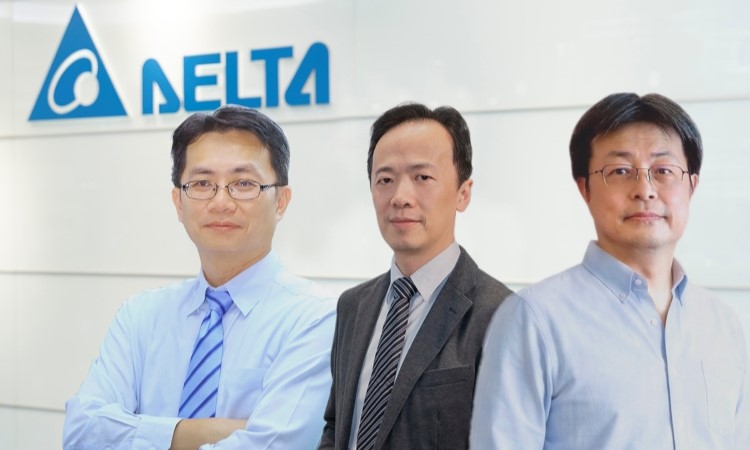
As artificial intelligence advances beyond simply “generating information” to “perceiving and controlling the physical world,” we are standing at a pivotal historical turning point. This digital twin disruptive innovation is no longer confined to back-end data analysis; rather, it empowers physical equipment, production lines, and even entire buildings with real-time understanding, autonomous optimization, and intelligent decision-making. In this issue of Brand News Bi-Monthly, we invited Kunyueh Lin, General Manager of the Intelligent Integration Services Business Unit from the Building Automation Business Group (BABG); Peter Chen, Factory Automation Solution Business Division Director of Industrial Automation Business Group (IABG); and Jacky Chen, Senior Manager of the Packaging Engineering Department of the Power and System Business Group (PSBG), to discuss how Delta leverages digital twin technology to bridge the virtual and physical worlds, transforming operations from "reactive correction" to "proactive prediction" across R&D, smart buildings, and smart manufacturing.
Establishing new standards for power and thermal management in the AI era
With the explosive growth in AI computing power, power supply design and system architecture face unprecedented thermal challenges. "The traditional 'build first, test later' hardware development model struggles to keep up," Senior Manager Jacky Chen points out, noting the challenges faced by the development team. Due to spatial interference and inadequate cooling, the team often discovers issues only after physical prototypes are completed, leading to costly redesigns and delays. To overcome physical validation bottlenecks, PSBG established a powerful virtual digital twin platform centered around its professional lab. This allows engineers to perform comprehensive simulations before hardware is built, identifying risks early in the virtual environment.
“This is more than 3D modeling, but a digital replica with a ‘physical soul.’ Our goal is not only technological innovation, but a revolution in development efficiency by shifting from physical testing to a digital-first approach,” said Senior Manager Chen. This simulation-driven design evaluation framework enables the team to use self-developed tools to concurrently evaluate power conversion efficiency, thermal distribution, and airflow impedance early in development, screening for the optimal configuration. What the team takes pride in is their ability to perform closed-loop calibration between real-world data and the model, continuously optimizing parameters to better match real operating conditions and forming a cycle of “visualization, predictability, and optimization.” When power solutions enter physical AI scenarios, digital twin technology further enable early prediction of load changes and thermal risks, supporting clients in rack-level power planning and forecasting before deployment, building the most solid energy support for hardware validation and operational stability.
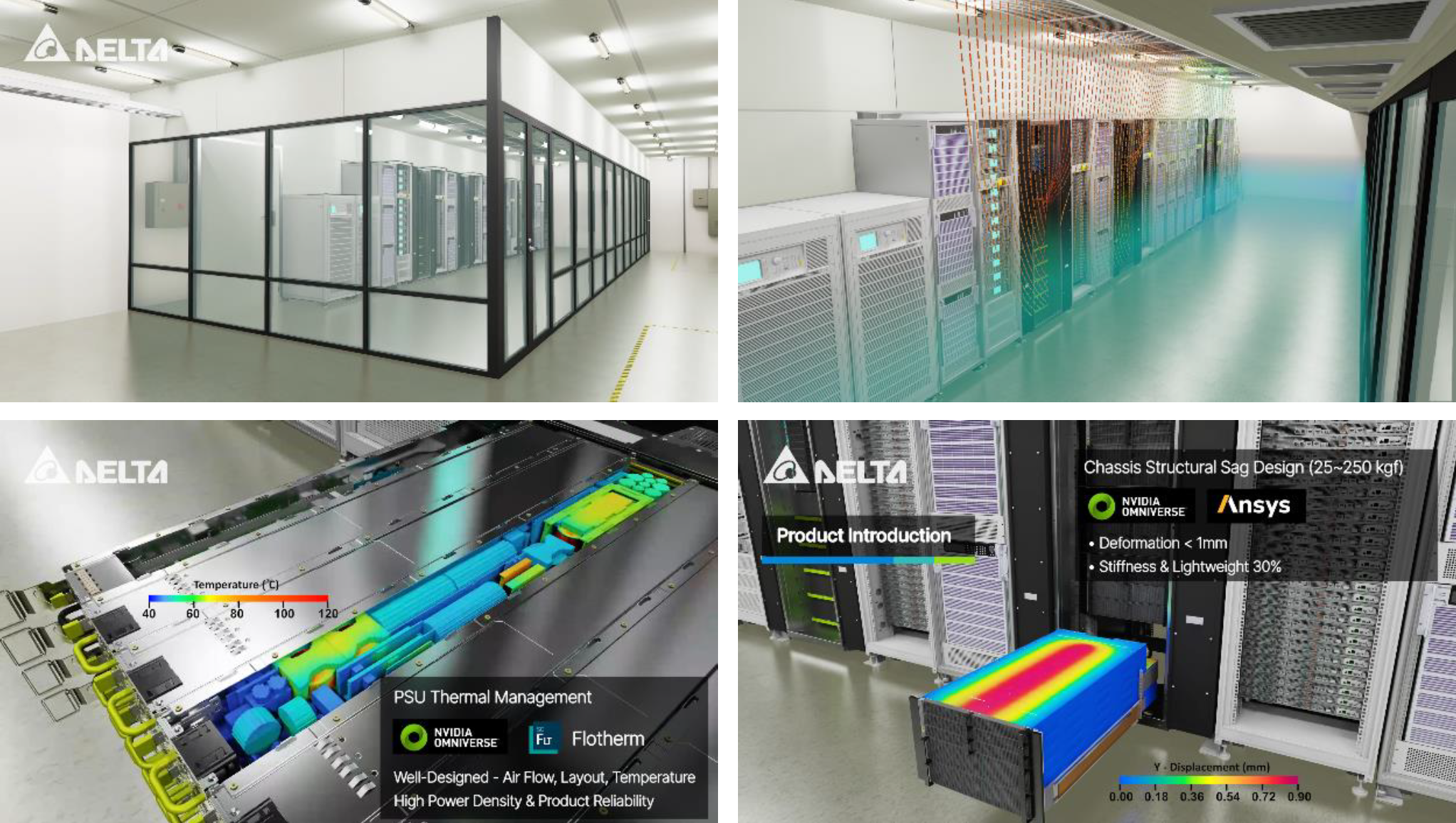
"VIrtual digital twin platform" centered around the SIT Lab
Bringing buildings to life: from "post hoc remediation" to "predictive optimization"
When digital twins are applied to buildings, the transformation is equally profound. General Manager Kunyueh Lin shared with the interview team that energy conservation and comfort in buildings were often seen as difficult to reconcile in the past. Traditional building management mostly relied on reactive strategies, issuing warnings only after equipment anomalies or overheating occur. Today, Delta integrates systems through digital twins to create buildings that learn and adapt autonomously. He led the BABG team to create a precise virtual replica for buildings, allowing AI to serve as the commander of an entire building, breaking down silos between HVAC, lighting, security, and access systems, and enabling coordinated operation based on real-time occupancy and environmental needs. AI dynamically adjusts temperature, lighting, vehicle guidance and security configurations based on grid load and electricity usage. At the same time, the system continuously learns user behavior patterns and, through adaptive control, automatically adjusts to the optimal control mode, achieving deeply predictive intelligence. "Buildings are no longer static spaces, but 'dynamic living organisms' with perception capabilities. For business leaders and senior managerial officers, digital twins are not just a technology upgrade, but an insurance and lever for operational performance."
Through high-precision edge computing sensing technology, temperature difference can be accurately inferred in areas where personnel are active, resolving the energy miscalculation caused by traditional wall-mounted thermostats. In the face of physical constraints that are difficult to change after a building has been completed, such as severe west-facing sun exposure issues, AI can incorporate environmental parameters such as solar irradiation trajectory and automatically compute the optimal compensatory control logic. In addition, digital twins are also excellent for disaster prevention drills; before heat waves or heavy rain occur, the system can perform predictive simulations and proactively pre-cool the building or activate protection mechanisms.
By shifting maintenance work from “post equipment damage” to “before parts fail,” Delta successfully transforms building operations into data-driven, precise decision-making. We also provide companies with the perfect solution for pursuing decarbonization targets without compromising comfort, creating genuine sustainability competitiveness for enterprises in the carbon-neutral era.
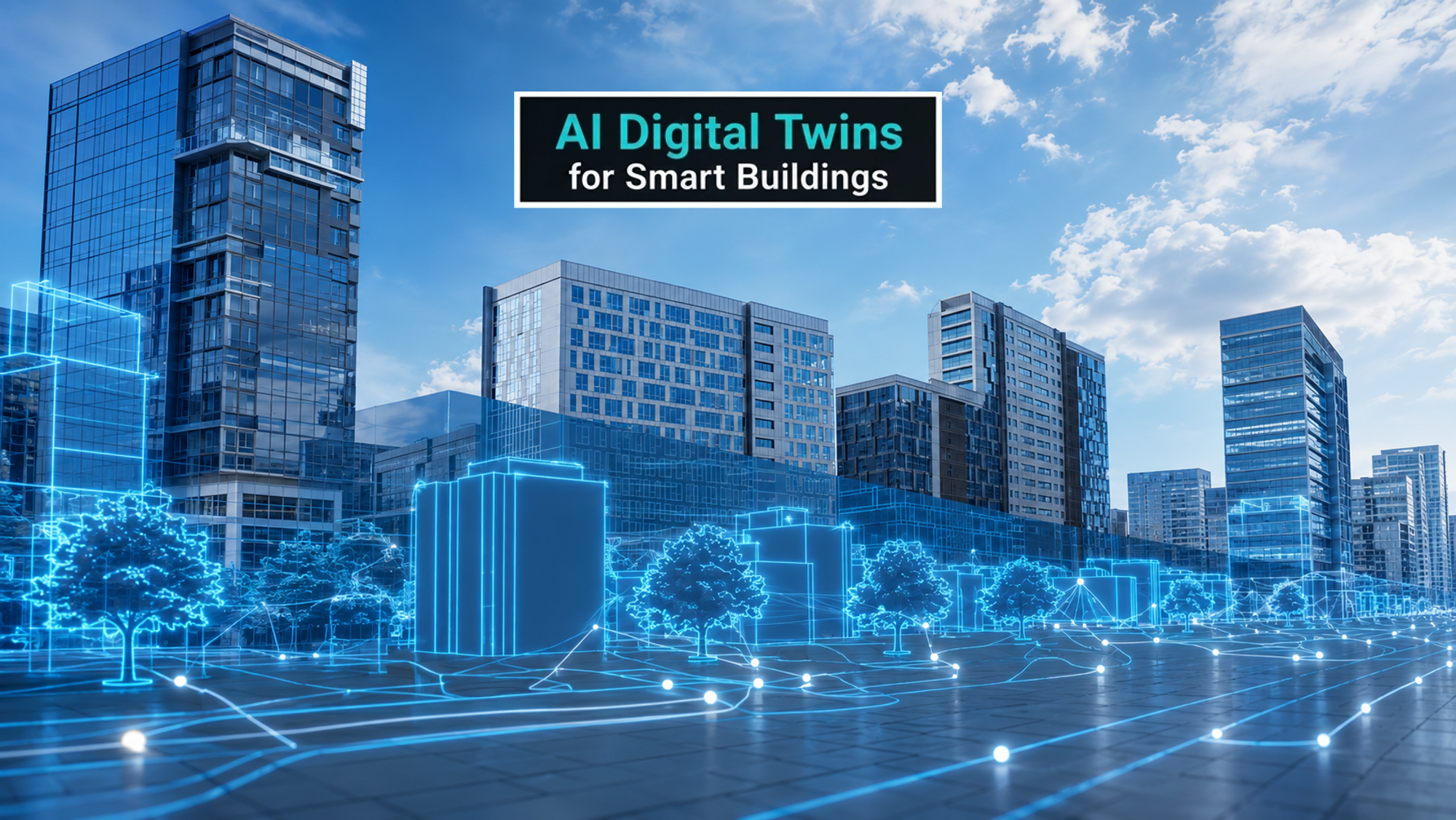
Delta creates an intelligent space through "cross-system integration" and "adaptive control"
Building thinking smart factories: from "trial-and-error" to "precise global replication"
In manufacturing, as AI evolves from an analytical support tool into a "digital employee" capable of directly optimizing manufacturing processes and equipment parameters, the bottleneck in traditional manufacturing, which had relied heavily on trial-and-error processes conducted on-site, received a fundamental solution. "Delta has manufacturing bases all around the world. These highly complex and diverse environments are exactly where digital twins can be most valuably implemented," said Director Peter Chen, full of anticipation for Delta's AI-driven manufacturing innovations in recent years.
To address the demands of distributed manufacturing and global deployment, through its DIATwin platform, Delta conducts simulation and optimization in virtual environment before synching with real-time data, continuously iterating to form a self-optimizing system. This establishes an autonomous, closed loop between simulation and execution, enabling AI to control manufacturing effectively and adapt dynamically, thereby redefining the standard for operational performance. “We do not start from ‘finding applications for AI’; we start from ‘real-world scenarios and build AI from there.’ Digital twins have evolved from visualization tools into the digital core of factory operations, enabling replicable, optimizable, and continuously improving smart manufacturing systems through virtual-physical integration.” The new product introduction stage phase is traditionally the most capital-intensive, but through highly realistic physical modeling, AI-driven calibration, and cross-disciplinary simulation, Delta significantly reduces discrepancies between virtual plans and actual production, breaking the trial-and-error manufacturing process. More importantly from a strategic perspective, digital twins enable manufacturing expertise to move beyond the tacit knowledge of seasoned technicians, transforming it into standardized digital models. This digitalization of manufacturing experience allows enterprises to rapidly replicate production across regions. By transforming the deep hardware-software integration experience accumulated within its own factories into scalable solutions, Delta is leading customers beyond conventional equipment procurement and taking a massive leap toward next-generation process optimization, globally coordinated production, and AI-driven decision-making.
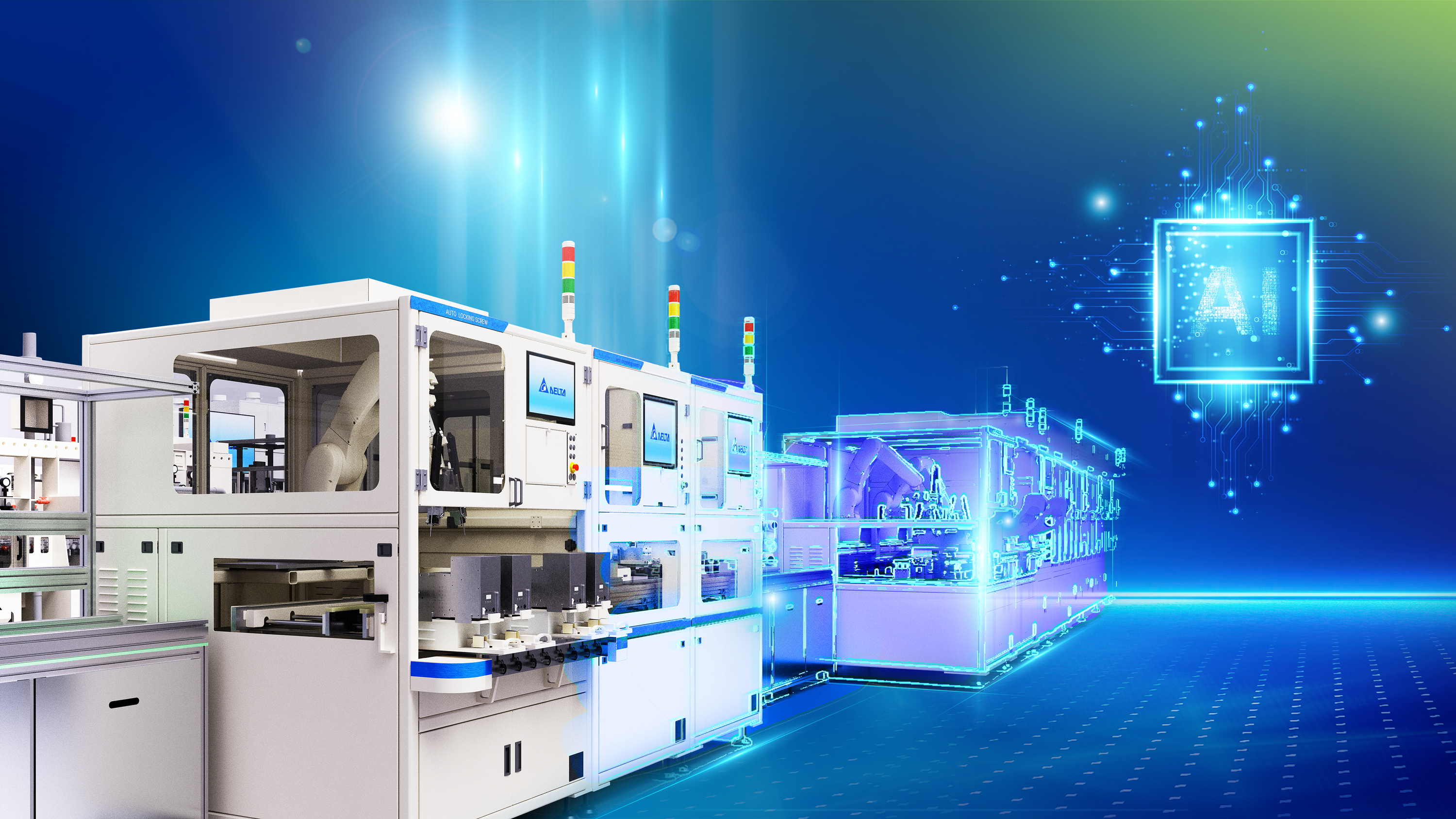
Delta establishes replicable, optimizable, and continuously improving smart manufacturing systems built on virtual-physical integration
By pivoting from physical trial-and-error to a digital-first approach, Delta not only significantly shortens the development cycle but also establishes a solid foundation for a new standard of energy efficiency in AI high-computing environments. By bridging the virtual and physical worlds across AI data centers, smart buildings, and global smart factories, the combination of digital twins and AI moves beyond vision into reality, delivering tangible productivity and decision-making power. With its strong integration capabilities, Delta is collaborating with global partners to drive sustainable transformation while relentlessly pursuing peak operational efficiency.