
The electric vehicle (EV) industry is undergoing an unprecedented technological revolution. From electrical architectures to powertrains, every innovation is redefining the standards of future mobility. In 2024, global EV sales reached 17.3 million units, marking a 25% increase from 2023. The most disruptive emerging technologies are now propelling the entire industry toward a smarter and more efficient new era.
E/E architecture revolution: from decentralization to smart integration
The traditional distributed architecture of vehicles—comprising 70 to 150 ECUs (Electronic Control Units)—is rapidly evolving toward a regionalized control model. The next-generation regional architecture integrates 4 to 6 regional controllers that centrally manage all sensors, actuators, and power distribution within each region, reducing wiring harnesses by 40-60% and significantly lowering system complexity. The Tesla Cybertruck pioneered the adoption of a 48V system, replacing the decades-old 12V architecture. This innovation reduces current to one-fourth at the same power level, minimizes energy loss, and provides a robust power foundation for high-performance in-vehicle electronic systems.
AI and digital twin integration: a new frontier in intelligent management
AI-driven smart systems are enhancing every aspect of electric vehicle performance, encompassing predictive maintenance, smart route optimization, battery health management, and energy consumption forecasting. Through the creation of highly realistic virtual models, digital twin technology enables the simulation of diverse operational scenarios during the development phase, significantly reducing physical testing costs and accelerating product development cycles. Once in mass production, fleet data continuously refines these models, forming a closed-loop optimization system that connects design, production, and operation—transforming electric vehicles from passive tools into smart partners capable of active learning.
The rise of 800V high-voltage platforms: a fundamental change in charging experience
The 800V high-voltage platform is rapidly expanding from luxury brands into the mainstream market, with a current penetration rate of around 15–20% and projections reaching 40–50% by 2030. Compared with 400V systems, 800V platforms enable ultra-fast charging up to 350 kW, reducing 10–80% charging time to just 15–20 minutes. Silicon Carbide (SiC) power devices—known for their low switching losses and high-frequency performance—have become the core technological pathway for 800V traction inverters and onboard chargers.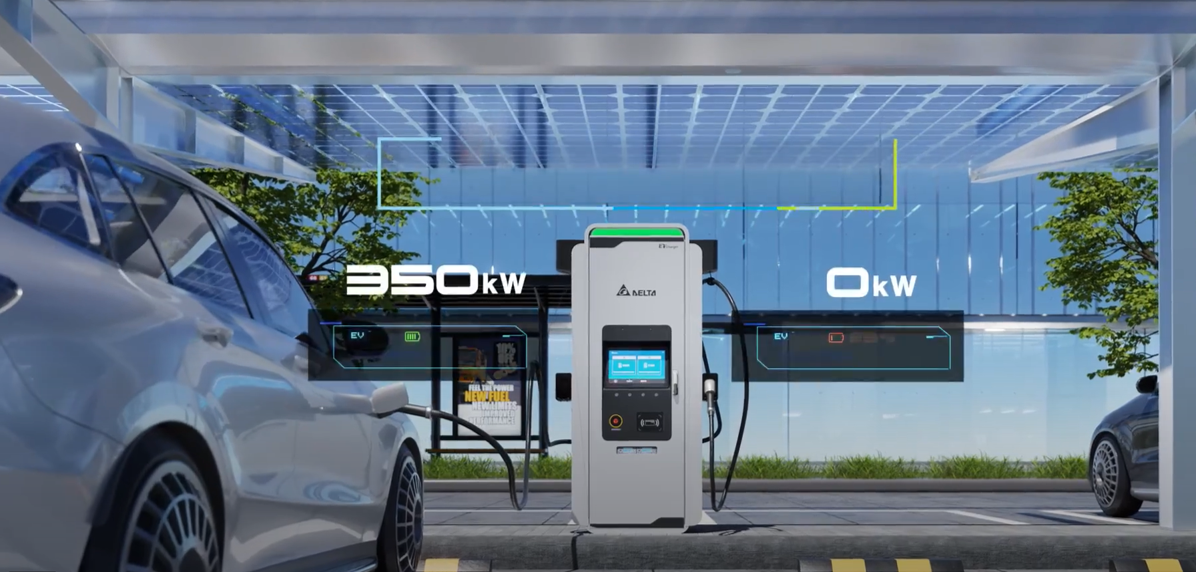 Delta High Power Charger 350 kW DC fast charging station features high power output and dynamic load distribution technology.
Highly integrated electric drive systems: a revolution in powertrains
Electric vehicle powertrains are undergoing revolutionary integration, evolving from traditionally separate motors, reducers, and inverters into compact “three-in-one” e-Axle modules. Some manufacturers have gone further, offering “multi-functional” highly integrated systems that incorporate features such as On-Board Chargers (OBC) and DC-DC converters. This level of integration significantly reduces size and weight, enhances system efficiency and reliability, and streamlines manufacturing processes, driving down overall EV costs.
Next-generation battery and energy management technologies
Battery technology continues to advance, evolving from LFP (Lithium Iron Phosphate) and NCM (Nickel Cobalt Manganese) to CATL’s M3P (Manganese-rich Phosphate), with continual improvements in energy density and safety. CATL’s Qilin battery, featuring the CTP (Cell to Pack) 3.0 structural innovation, achieves a volumetric utilization rate of 72%. In addition, advanced energy recovery technologies are rapidly progressing, integrating regenerative braking, solar rooftops, and V2G (Vehicle-to-Grid) bidirectional charging, enabling deep interaction with smart grids.
Delta’s innovation strategy
Leading EV Power Management Technologies, Delta Electronics demonstrates strong innovation momentum in the electric vehicle sector. Its new-generation DC fast charging solutions feature a modular design supporting multiple power configurations, equipped with SiC power devices and liquid-cooling technology, achieving charging efficiency above 96% while integrating intelligent load balancing capabilities.
In the future, next-generation EV power systems are evolving toward higher power densities. By integrating power switches, driver circuits, and protection components into automotive-grade WBG (Wide Bandgap) semiconductor power modules, heat dissipation is significantly improved and system reliability enhanced. Delta continues to innovate in the EV sector, boosting power conversion efficiency and reducing system energy consumption, collaboratively creating a greener and smarter era of mobility with its business partners.


