
India’s energy system is evolving quickly. As renewable capacity continues to grow, the focus is no longer only on how much clean power we add to the grid, but on how reliably that power can be used. Solar and wind are now an integral part of India’s energy mix, but their variability brings everyday operational challenges. Managing peak demand, balancing supply, and keeping the grid stable have become regular concerns. This is where energy storage is beginning to make a real difference.
Battery Energy Storage Systems, or BESS, are steadily moving beyond pilot projects into actual deployment. Utilities and developers are no longer treating storage as an experiment. Instead, it’s being seen as a practical tool—one that can absorb excess renewable power, supply electricity during peak hours, and support grid frequency and voltage when needed. Across cities as well as state-level networks, storage is helping power systems respond faster and operate with greater confidence.
Diverse applications tailored to local conditions
As part of this shift, Delta Electronics India is contributing to the country’s growing energy storage landscape by supplying 100 units of its Made-in-India 1.1 MW bi-directional Power Conditioning Systems, adding up to a total capacity of 110 MW. These systems are being deployed across multiple energy storage projects in collaboration with Prostarm Info Systems Ltd. The deployments include projects linked to Bihar State Power Generation Company Ltd. and Adani Electricity Mumbai Limited, showing how storage is being adopted by utilities working in very different grid environments.
One of the most interesting aspects of these projects is the range of applications. In Mumbai, an 11 MW / 22 MWh BESS project is being implemented to support a dense urban distribution network, where reliability and peak load management are critical. At the same time, standalone energy storage projects are being developed in Bihar under the BESSPD (Battery Energy Storage Solution Power Developer) model. These projects treat storage as an independent grid asset, helping strengthen state-level power systems and improve operational flexibility. Together, they show that energy storage is being shaped around local needs rather than a single, uniform use case.
Superior performance meets flexible deployment
At the centre of these deployments are Delta’s Power Conditioning Systems, manufactured at the company’s facility in Krishnagiri, Tamil Nadu. In any energy storage project, the PCS plays a vital role—it forms the connection between the battery and the grid, ensuring power flows safely, efficiently, and reliably in both directions. In practical terms, this enables applications such as peak shaving, smoothing renewable power output, and providing grid support during periods of stress.
From a performance standpoint, the systems are built for utility-grade operation. They offer energy conversion efficiency of up to 98.5 percent, support output power capacity of up to 1160 kVA, and can operate with up to five units running in parallel. This modular, scalable design allows systems to be sized according to project needs today, while also leaving room for future expansion, rather than forcing rigid system layouts.
Another important element of these deployments is the focus on local manufacturing. Producing Power Conditioning Systems in India supports supply chain reliability and also makes long-term maintenance and service easier. As energy storage installations continue to grow in both number and scale, having locally manufactured, well-integrated systems becomes increasingly important for smooth execution and dependable lifecycle support.
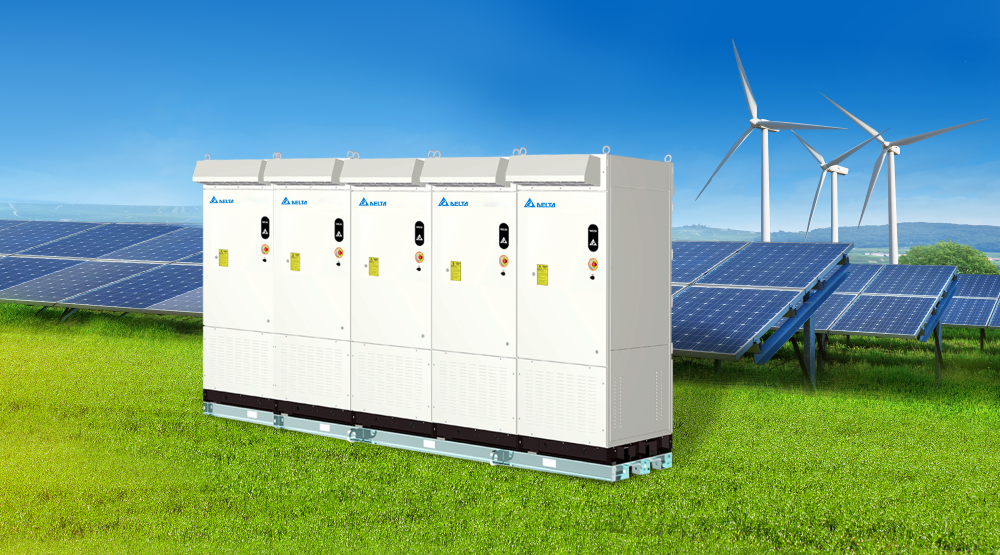
Delta powering India’s expanding energy landscape
Looking ahead, energy storage will be less about individual projects and more about how seamlessly it fits into the broader power ecosystem. As renewable penetration increases, the grid will need assets that can respond quickly, operate efficiently, and scale over time. Storage will play a growing role in strengthening grid resilience, enabling higher renewable absorption, and giving utilities more flexibility in how they manage power systems.
Efforts like these reflect how energy storage in India is moving steadily from concept to implementation. The focus is shifting toward integration, reliability, and performance on the ground. Through locally manufactured power electronics and scalable system design, Delta Electronics India is contributing to this transition—helping build a power infrastructure that is better prepared for the realities of a changing energy landscape.

2026/08


